
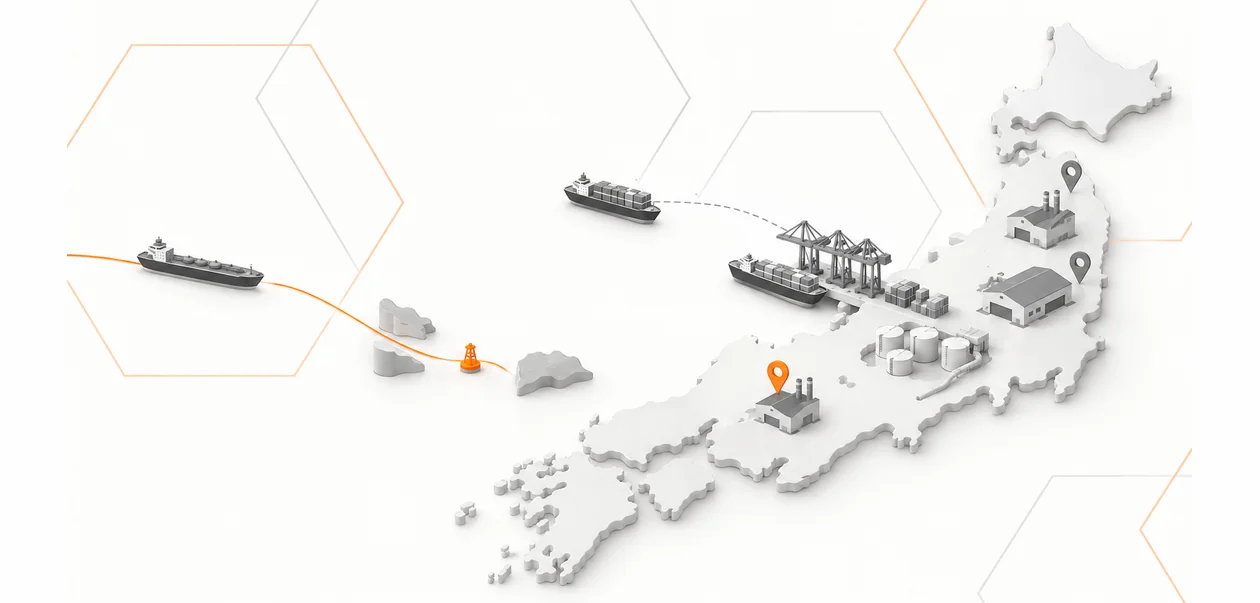
Four new context layers in Kabuken: maritime warnings, export controls, oil dependency and company sites
Annual reports tell you what a company says about its own business. Some of what moves a Japanese company sits outside the filing: a shipping lane, a US export-control list, how much of the country's crude oil comes from one region. Kabuken now carries four more sources of that context, each tied to a named official publisher, and each readable by you or by an AI client through the Kabuken MCP server.
The purpose is to track risks in a company's supply chain: the sea lanes its goods and raw materials travel through, export controls on the companies it buys from and sells to, the energy it depends on, and where its own sites are.
Kabuken does not provide stock prices or investment advice. These are reference layers for research.
In short: maritime warnings from the US NGA, Japan-relevant rows of the US BIS Entity List, METI's monthly Middle East share of Japan's crude imports, and a company's listed sites from its annual report. Each keeps its named source.
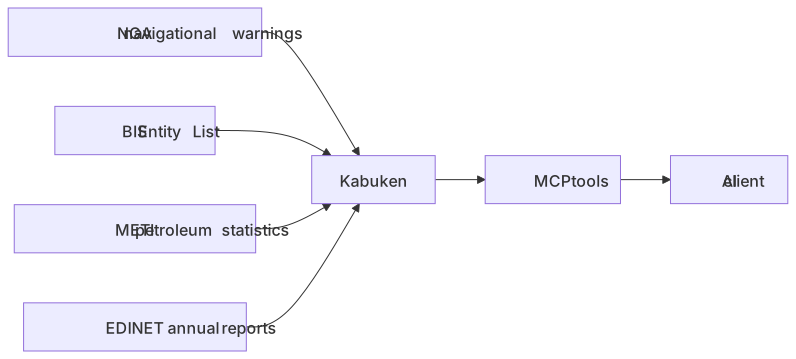
1. Maritime warnings at chokepoints (US NGA)
The US National Geospatial-Intelligence Agency publishes navigational warnings as part of its Maritime Safety Information. Kabuken reads them and rates each one by what kind of warning it is and where it applies. The rating looks at nine chokepoints, including the Strait of Hormuz, the Suez Canal, the Strait of Malacca and Singapore, and the Taiwan Strait; the full list and the rules are in the market events guide.
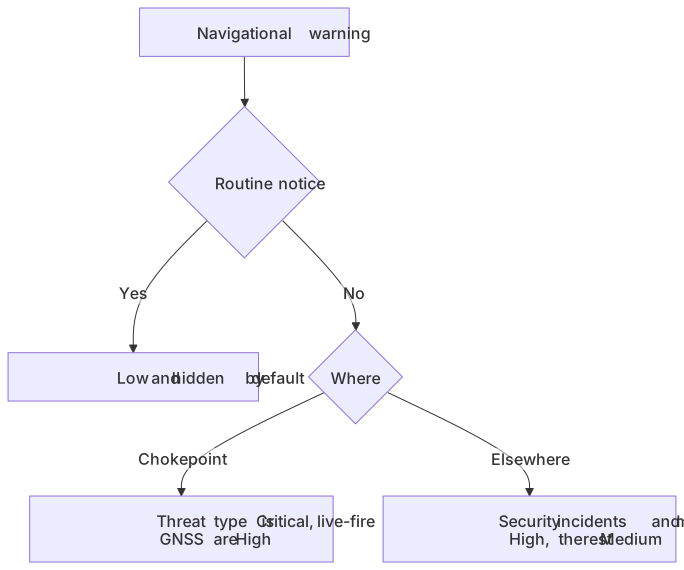
Routine notices such as survey work and buoys are hidden by default, so the feed stays about threats. If you want them, set include_routine_warnings on the get_risk_context MCP tool. The tool returns the last 30 days of warnings (up to 10, newest first) as recent_maritime_warnings, with the source attribution alongside, next to BOJ rate sensitivity and the METI export-control classification.
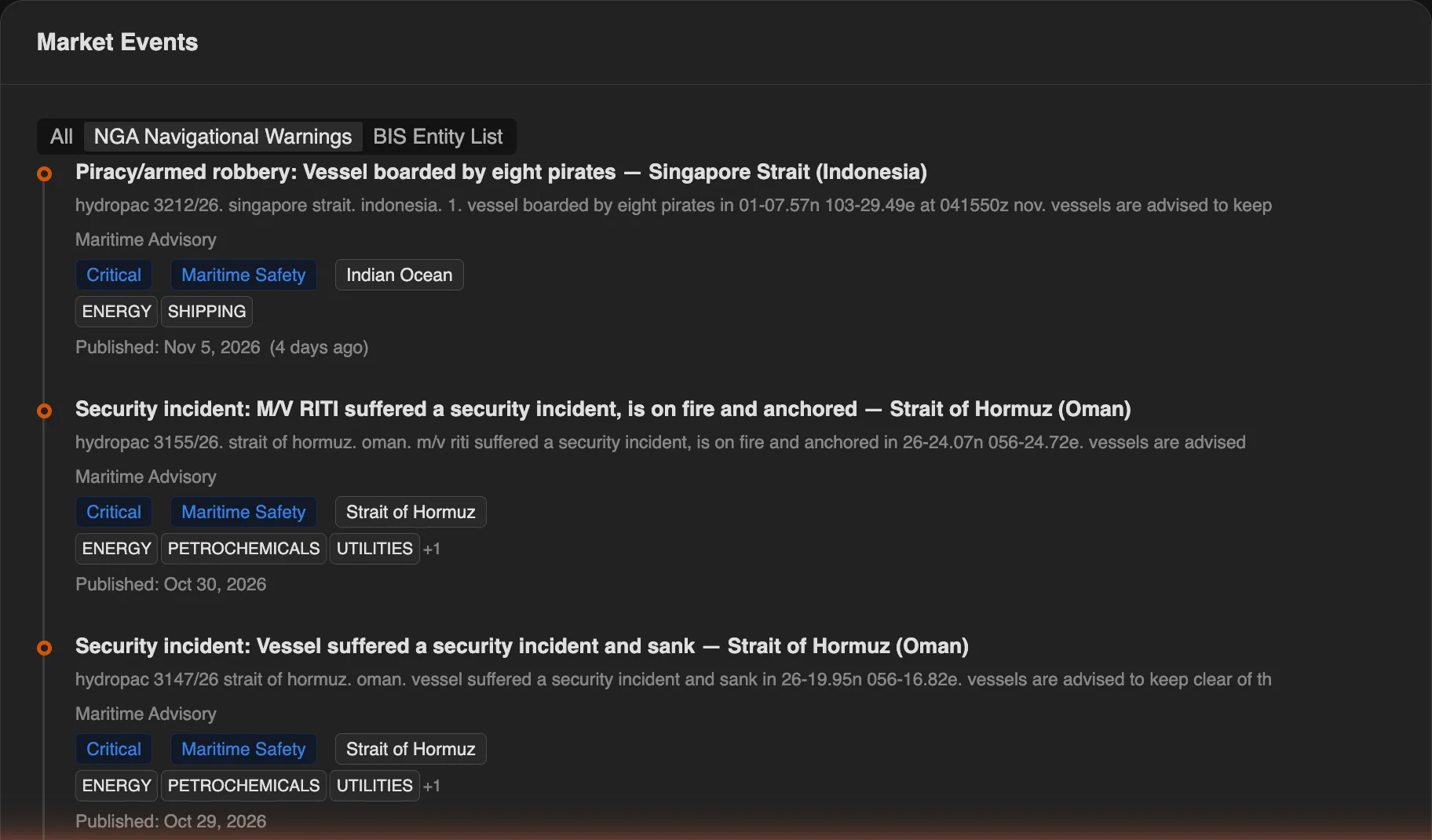
Source: NGA Maritime Safety Information (US National Geospatial-Intelligence Agency), https://msi.nga.mil/. US government work (NGA Maritime Safety Information).
2. BIS Entity List: the Japan-relevant listings
The US Bureau of Industry and Security keeps the Entity List, an export-control list (under the Export Administration Regulations) that matters most for semiconductors, industrial equipment and advanced materials. Most of its rows have little to do with Japanese companies, so Kabuken shows the ones that do.
Among the entities currently on the list, entries linked to Japan are shown first, and so are entries from a curated list of groups in the semiconductor supply chain, in any country. Newer listings rate higher; everything else is Low and hidden by default. The curated groups include Huawei, SMIC and YMTC.
For Japanese companies the link is usually indirect: a listed entity is a customer of Japanese equipment, materials or component makers, and a listing changes the licence requirements for sales to it.

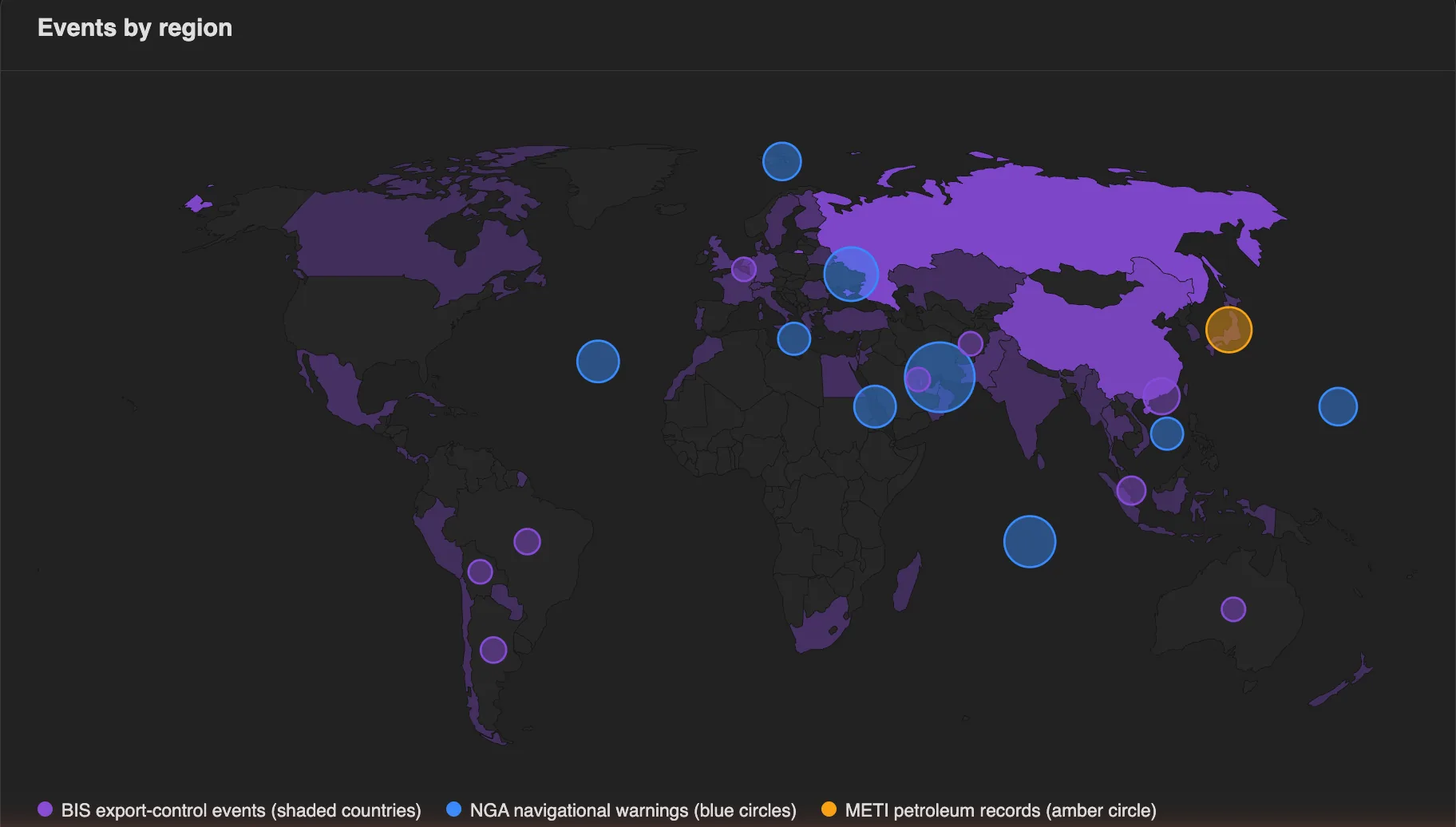
On the Events page, BIS listings appear as shaded countries on the "Events by region" map, next to the NGA warnings and the METI record, and a source filter narrows the list to the Entity List alone. Each card names the entity and its country and shows the type (Export Control), the severity, the region, the affected sectors and the published date. The counts on the map are counts of published events; they are not a measure of impact on any company.
The event date is the effective date of the listing (the Federal Register effective date), not the day Kabuken loaded it. That matters if you are reconstructing a timeline.
3. Japan's Middle East crude-oil dependency (METI)
Each month the Ministry of Economy, Trade and Industry publishes crude-oil imports by country. Kabuken takes the latest month, divides the Middle East total by the overall total, and records one event. The Middle East grouping is METI's own definition, and the figure is METI's own statistic.
The event is dated the last day of the data month and carries the total imported and the Middle East share. Severity rises with the share, in four bands (see the guide for the cut-offs). Japan's share has sat in the top band for years; the bands exist so that a structural change would show.
This is a measure of structural exposure to a supply disruption. It is not a week-on-week signal and it says nothing about price. It is most relevant to refiners and petrochemical makers, and also to shipping companies (tanker operators) and trading houses with upstream stakes, as well as energy-intensive manufacturers.
Source: Ministry of Economy, Trade and Industry (Government of Japan Standard Terms of Use, PDL 1.0 compatible).
4. Company sites from the annual report
Japanese annual reports (有価証券報告書) list a company's major facilities in the facilities section (設備の状況) for the filer and its consolidated subsidiaries, and Kabuken's get_company MCP tool, called with include_sites: true, now returns those listed sites as sites: a home_country, a total_sites count, a breakdown by_country (each country marked with a scope of domestic, foreign or unknown) and by_prefecture, a by_precision summary of how precisely each row's location is given, and the source filing, counted as the filing lists them rather than by size, book value or headcount.

Field reference: get_company in the MCP tools documentation.
Using it with an AI client
Connect the Kabuken MCP server to Claude or another MCP client, then ask in plain language. For example: "Show recent threat-type maritime warnings at chokepoints, with sources," or "What is Japan's latest Middle East crude-oil share, and which sectors does it concern?" or "Where does this company list its major sites, and in which filing?" The answer comes with the named source, so you can check it.
Setup instructions are in the Kabuken documentation: https://kabuken.intellics.ai/docs/en/?utm_source=blog&utm_medium=referral&utm_campaign=2026-11-09-features
What this is not
It is not a forecast and it does not tell you what a company's results will be. A warning at a chokepoint or a row on an export-control list does not mean a given company is affected; the filing is where you check that company's own disclosure.