

Read more of a Japanese annual report through Kabuken MCP: people, officers, owners and any single fact
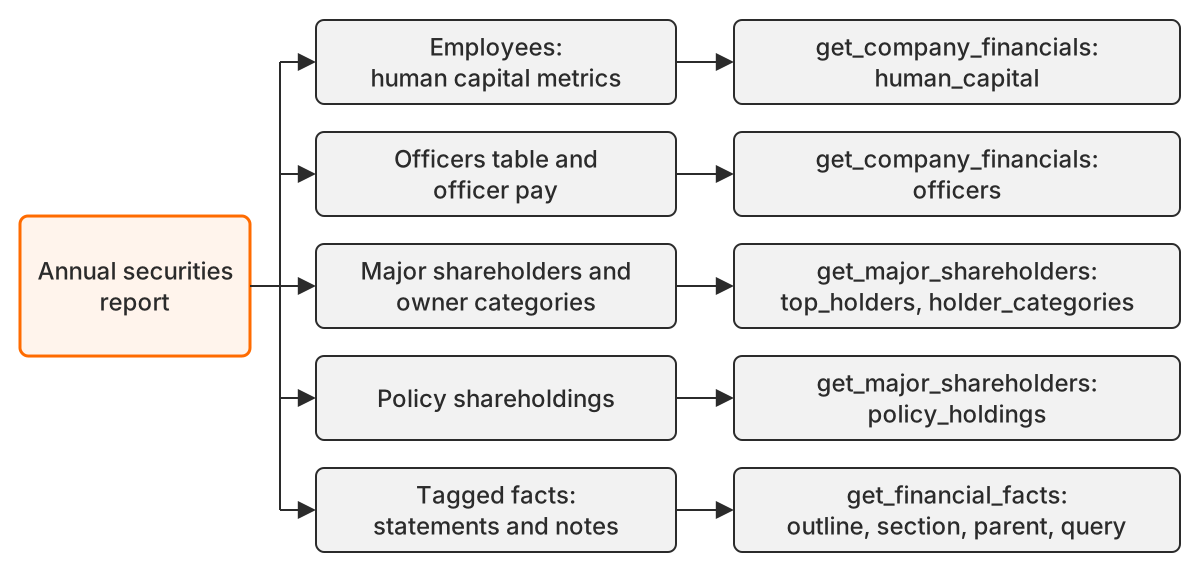
The annual securities report (有価証券報告書) holds much more than the financial statements. It says how many of a company's managers are women, who sits on the board and who is expected on it after the annual general meeting, who owns the shares, and which other listed companies' shares the company keeps for business reasons.
This week the Kabuken MCP server added five things that make those parts readable by an AI assistant. Each section below starts with a question an analyst asks, then shows what to ask the assistant and what came back when we asked it. Every figure comes with the filing it was read from, so you can open the original table and check it.
Kabuken does not provide stock prices or investment advice. These figures are what the companies filed.
1. Human capital: what the company filed about its people
The question. What share of managers are women, how many male employees took childcare leave, and how large is the gender wage gap?
Ask the assistant.
"How many of Sony's managers are women, how many male employees took childcare leave, and what is the gender wage gap? Show the filing."
「ソニーグループの女性管理職比率、男性の育児休業取得率、男女の賃金の差異を、出典の有価証券報告書つきで教えてください。」
What comes back. The figures as filed in the latest annual report, for the reporting company and, separately, for each consolidated-subsidiary row the filing lists. Each subsidiary row carries the company name the filing tags for it, and is empty there when the filing tags none. The male childcare leave rate stays under the legal basis the company used: one of the two methods of the ordinance under the Childcare and Family Care Leave Act, or the method of the Act on the Promotion of Women's Active Engagement. The bases are defined differently, so the response keeps each rate under its own key instead of putting them in one column. Where the company split the rate or the wage gap into regular and non-regular employees, that split is kept.
A zero the company filed is returned as zero. A cell the company left blank is returned as empty, not as zero.
Example (Sony, latest annual report, EDINET doc ID S100YE2C). Women hold 20.5% of management positions. The male leave rate is filed on the basis that also counts leave for childcare purposes, and it is 84%. Women's pay is 82.8% of men's for all employees, 83.4% for regular and 66.9% for non-regular employees. Each figure carries its XBRL concept.
2. Officers: names and roles as filed, the board expected after the AGM, people paid but no longer in office
The question. Who are the directors, and who is expected on the board after the annual general meeting?
Ask the assistant.
"Who sits on Sony's board according to its latest annual report, and who is expected on it after the June 2026 AGM?"
「この会社の役員を有価証券報告書の記載どおりの役職で一覧にし、定時株主総会後の役員の予定も分けて示してください。」
What comes back. Every person in the officers table, with the name and title in Japanese as filed, and the table that lists them: directors and auditors, executive officers of a company with a nomination committee, or both. Individual pay appears where the filing discloses it, which is only for officers paid ¥100 million or more. The response also gives pay by officer category (for example directors, outside directors, auditors) and the board's male and female counts with the female ratio.
Two groups are kept separate from the officer count. People who were paid during the year but hold no office at the filing date are listed and counted on their own (paid_only_count). The officers the filing expects after the annual general meeting come in their own list (candidates) and are not counted as officers. That table can include continuing officers who are not up for election, so its length is not the number of people elected.
Example (Sony, EDINET doc ID S100YE2C). 15 officers at the filing date, 10 men and 5 women. The candidates list has 10 names, and all 10 were elected at the AGM on 23 June 2026.
Example (Toyota, latest annual report). 10 directors at the filing date, 8 men and 2 women, with Akio Toyoda as 取締役会長(代表取締役).
3. Ownership: top holders, owner categories and policy shareholdings
The question. Who are the largest shareholders according to the annual report, how is ownership split between owner types, and which listed shares does the company hold for business relationships?
Ask the assistant.
"Who are Nintendo's largest shareholders in its latest annual report?"
"Which cross-shareholdings does Toyota keep, and why?"
「この会社の政策保有株式を一覧にして、保有目的と、相手先が当社株式を保有しているかどうかも示してください。」
What comes back. Three parts read from the latest annual report, next to the large shareholding reports (大量保有報告書) that the tool already returned:
- Top holders (大株主の状況): rank, name and address as filed, shares held and the shareholding ratio.
- Owner categories (所有者別状況): shareholder count, units held and ratio for the seven owner categories that EDINET uses, per share class.
- Policy shareholdings (政策保有株式): specified investment shares and deemed holdings, each row with the issuer name as filed, shares and book value at the current and prior year end, the holding purpose, and the filing's own answer on whether that issuer holds the company's shares. A row whose current-year cells are blank, meaning the issuer is no longer held at the year end, is marked
held_at_year_end: false. Each row also has a scope: the company's own holdings, or those of the group companies with the largest and second-largest holdings when the filing reports them.
Where a company marked a figure as below the disclosure threshold, the row says so instead of showing zero. Names are as filed, in Japanese; Kabuken does not match holders or issuers to EDINET codes.
Example (Nintendo, EDINET doc ID S100Y9NX). The top three holders are The Master Trust Bank of Japan (16.05%), Custody Bank of Japan (5.02%) and a JPMorgan Chase Bank account numbered 380752 (3.75%).
Example (Toyota). The policy-holding tables list 42 issuers: 37 specified and 5 deemed. 8 of them, including all 5 deemed holdings, were no longer held at the year end. The largest holding is KDDI, at a book value of ¥989.6 billion, held for the stated purpose 「自動車関連(情報)取引の維持・発展」 (keeping and developing automotive-related information business). NTT (¥317.4 billion) and MS&AD (¥283.7 billion) follow. For all three, the filing answers that the issuer holds Toyota shares too.
4. Smaller responses by default
The question. Why give the assistant less text for the same answer?
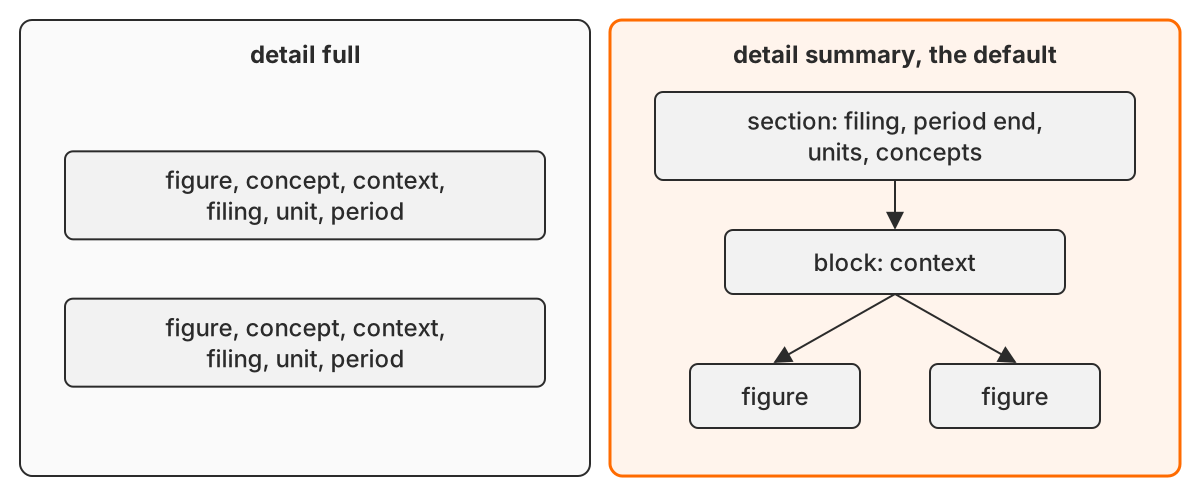
A response repeats where each figure comes from: the filing, the XBRL concept, the context. For a group with many subsidiaries or a bank with a long list of holdings, that repetition made responses very large, and a response the assistant cannot read in full is a response nobody can check.
The default is now detail: "summary". It keeps every figure and every field, and states the source once per section and once per block instead of on every number. Long lists come as tables with named columns. Policy shareholdings arrive 40 rows per page or fewer, with a cursor for the next page. When you ask only for human capital or officers, the response no longer carries the headline financials you did not ask for.
detail: "full" repeats the source on every figure. Use it when you want to cite each number on its own.
"Use full detail: I need the concept and context of every figure."
「各数値の要素名とコンテキストが必要なので、detailをfullにして取得してください。」
5. Any fact in a filing, step by step
The question. Where in this filing is the figure I need, and what sits under it? A line of the income statement, a note to the financial statements, a row of the statement of changes in equity.
A filing holds hundreds of tagged facts. Asking for all of them at once is slow to read and easy to misread. get_financial_facts now lets the assistant go down one level per call:
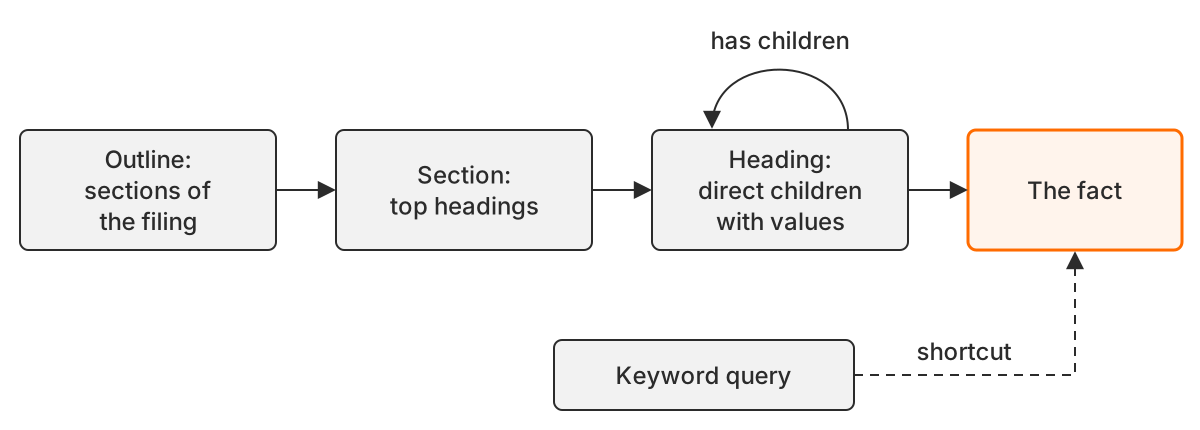
The outline lists the sections of the filing, such as the statements, the notes and changes in equity. Each entry carries the exact arguments of the next call, so the assistant does not have to guess a concept name. The keyword query is the shortcut: it searches the English labels, Japanese labels and concept names of the facts in the whole filing. Company details such as the name, codes and filing list come from the get_company and list_documents tools, not from this descent.
"Find Toyota's revenue split in the filing itself."
「この有価証券報告書の区分を一覧にして、損益計算書の営業収益の内訳までたどってください。」
Example (Toyota, EDINET doc ID S100Y8NY, fiscal year to March 2026). Three calls: the outline, then the income statement section, then the revenue heading the second call pointed to. The result: sales of products ¥45.866 trillion and financing revenue ¥4.819 trillion, total revenues ¥50.685 trillion, with the prior year beside each line. The assistant needed no concept names.
Using it
Connect the Kabuken MCP server to Claude or another MCP client and ask in plain language; the client picks the tools. Setup and the full field reference are in the Kabuken documentation: https://kabuken.intellics.ai/docs/en/?utm_source=blog&utm_medium=referral&utm_campaign=2026-11-17-new-features
Field reference for all five features: MCP tools reference.
Plugin 2.2.2
The MCP tools are hosted and already updated for every client. Plugin 2.2.2 adds three skills that tell the assistant which tool to use for each kind of question:
find-a-fact: finds any single fact in a filing, step by step (outline, section, children). Try: "Find Toyota's revenue split in the filing itself."people-and-governance: officers and human capital of a company, from its latest annual report. Try: "Who sits on Sony's board according to its latest annual report, and who is expected on it after the June 2026 AGM?"ownership: top holders, owner categories and policy shareholdings. Try: "Who are Nintendo's largest shareholders in its latest annual report?"
The plugin ships with three starter prompts:
- "Screen Japanese electronics makers by operating margin in their latest annual reports, with each figure's source filing."
- "What is the gender pay gap at Toyota, and who are its directors?"
- "What were Sony's revenue and operating income in its latest annual report, and which filing are they from?"
Where to get it: Claude users get 2.2.2 from the Kabuken plugin repository (Claude Code: clone it and start with claude --plugin-dir): https://github.com/Intellics-ai/kabuken-mcp-plugin?utm_source=blog&utm_medium=referral&utm_campaign=2026-11-17-new-features . ChatGPT users get it through the Kabuken app in ChatGPT once the approved version is published.
Update steps: https://github.com/Intellics-ai/kabuken-mcp-plugin#update-to-the-latest-version
When to use Kabuken
Kabuken answers from the filings that Japanese listed companies submit to EDINET. Use it to:
- Screen a whole sector from your AI assistant on filed figures and list the companies that pass. Web search has no list of a sector's companies to work through.
- Ask what the annual securities report (有価証券報告書) says about officers and the board expected after the AGM, female managers, male childcare leave, the gender pay gap, major shareholders, owner categories, policy shareholdings, segments and notes, or find any single figure in a filing step by step.
- Check and cite each figure. It comes with the EDINET document ID of its filing, so you can open it.
For one headline figure of a large company, web search usually gets it right.
What this is not
These sections return what the company filed. They are not scores, they do not rank companies, and they do not tell you what a company's results will be. Some things the filing holds are not returned: officers' terms of office, dates of birth and career summaries. For those, the filing itself is the place to look.
Source: EDINET (Financial Services Agency, Japan), Public Data License 1.0. Data processed by Kabuken. Kabuken does not provide stock prices or investment advice.